
Air compressor fittings are essential to keeping your unit running efficiently and delivering the air power you require for your operations. This page will provide all the relevant information on air compressor fittings sizes, including both NPT fittings and metric fittings.
Table of Contents
- What Are Compressed Air Fittings?
- Air Compressor Fittings Sizes: The NPT Fitting Standard
- The Metric Fitting Standard
- Compressed Air Fittings – Considerations
- FAQs (Frequently Asked Questions)
What Are Compressed Air Fittings?
Air compressor fittings are attachments that help maintain a consistent flow of air and pressure throughout a compressed air system. Each fitting has a different role, but they are all important for managing your unit’s health and effective operation.
Compressed air fittings:
- Couplers
- Plugs
- Connectors
Couplers
Couplers facilitate the connection of an air tank or air compressor to the airlines. When you disconnect an air hose, the coupler closes to prevent air from escaping. Couplers come in a wide array of styles and sizes, including those designed for automotive, industrial, ARO, and V-style.
There are typically two main types of couplers; automatic and manual. Automatic fittings allow you to plug your airlines indirectly and quickly seal the air opening when the hose or male part is removed, which allows for the O-ring or female connection to completely close.
Manual couplers on the other hand require you to pull on the collar of the coupler to insert and remove the air hose. When you remove the airline, you should hold it tightly as the coupler will abruptly expel the tool as compressed air begins to escape.
Plugs
Couplers and plugs go hand in hand. Whichever style coupler you choose, you will need to choose the same style plug to be able to connect them. The most important specification of the plug to consider is the flow size, or the volume of air the plug can manage. Most standard air compressors tend to require a plug with a 1/2 inch or 1/4 inch flow size, with the latter being more common.
Just like couplers, plugs come in automotive, industrial, ARO, and V-style designs. It’s pretty much down to personal preference on the style you choose, though automotive and industrial designs are far more common and easy to find in most hardware stores. When buying an air compressor plug, quality and fit are the most important factors to consider, so it’s advised to opt for a brand with known quality to prevent compressed air leaks.
Connectors
Due to the fact that there are now so many different compressed air fittings, manufacturers have come to recognize how difficult it may be to find the one you need. For this reason, companies have now begun to color-coordinate their couplers and plugs, with the most common being:
- Automotive = red
- Industrial = green
- ARO = blue
- V-style = yellow
Visit our air hose fittings types guide for more information on these.
When you need to replace the fittings on your compressed air system, you will want to begin by checking the size you need. Most compressed air system fitting sizes follow the NPT (National Thread Tapered) standard, while others use Metric fitting standards, both denote the thread size but are different.
Air Compressor Fittings Sizes: The NPT Fitting Standard
A threaded boss is a threaded hole in the device or air tool into which you insert or thread a fitting. The boss could be in an air tool, an air valve port, an air cylinder port, an air manifold, or any number of other compressed air components all of which it is necessary to thread one or a number of air fittings in order to plumb them for working with compressed air.
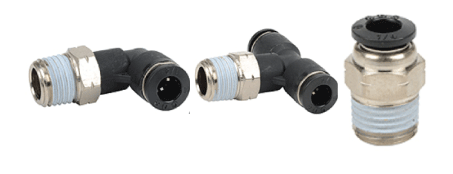
If a specific air fitting is manufactured to the NPT standard, it will have dimensional compatibility with other NPT threaded fittings of all other manufacturers. Which is another way to say that all NPT fittings are interconnective.
One manufacturer’s fitting can be replaced with the same NPT size fitting of another manufacturer, and both – assuming they are the same size – will fit the same threaded hole in your air cylinder, actuator, air tool handle, valve…or whatever the application is.
Different NPT Fitting Sizes
Fitting sizes can be a bit confusing! Do not make the assumption – as I used to – that a 1/4″ NPT fitting thread is anywhere near 1/4 inch in diameter! It’s not even close.
Visit your favorite hardware or plumbing store and ask for a 1/4″ fitting. The fitting they will show you will most likely be a 1/4″ NPT. You will look at the diameter of the thread, and say to yourself, this ain’t no 1/4″ fitting but it will be. The actual diameter of the 1/4″ NPT thread will be just over 1/2″.
The size of an NPT fitting, the 1/4″, the 3/8″, 1/2″, and so on, are reference sizes. The actual size of each is much larger than the fraction size they are supposed to be.
Air Fitting Type Chart – NPT Size
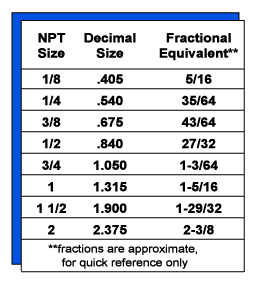
To help you get a grip on the actual sizes of NPT fittings, see the chart below. It shows the comparison between NPT fitting sizes and their actual inch equivalents.
On this chart, I have listed the NPT thread size first, then what that thread size is in actual (decimal) inches, and then the closest common size fraction to that NPT size.
Sizing the Hole or Fitting Port
To determine the size of a threaded airport in an air tool handle, air cylinder, valve, or female thread in any compressed air component, you will want to measure the width of the hole in inches. That’s the distance across the middle of the opening.
Compare that result to the fractional sizes on the chart to help guide you to the right male-threaded NPT fitting size to use.
NPT, as an acronym for National Pipe Taper, is an industry dimensional standard. The threads of different fittings with the same NPT size will connect, but that does not mean that all of the fittings will necessarily look the same.
Fittings and What You Need to Know
What do you need to know when you are trying to determine what fitting to use and where to use it?
You need to identify the…
- Port size/fitting thread size into which the male thread is screwed
- Size of tube or hose that you want to attach to the fitting; and note, tube, and hose do NOT connect the same way
- Style of fitting; whether it is a straight, elbow, Tee, Run Tee, etc.)
- The way the hose or tube is to be connected to the fitting
Air Fitting Sizes NPT Port
You will commonly see the following in NPT thread sizes:
- 10-32
- 1/8 NPT
- 1/4 NPT
- 3/8 NPT
- 1/2 NPT
There are certainly much larger NPT sizes. The sizes listed above are the commonest fittings in industrial compressed air applications.
How NPT Fittings Seal
When you thread the fitting into the hole in the valve, cylinder, or air tool, the NPT type thread seals by threading into – penetrating the threaded boss (the threaded hole) until it is tight. That typically means that sufficient threads on the fitting are interlaced with sufficient threads in the boss to generate a seal between the threads.
To aid in the thread penetration, and to help render the thread connection leakproof, it is common for folks to select Teflon tape as a sealing aid. They coat the male thread with the tape, allowing those male threads to turn deeper into the female boss than would be possible without the thread, and improving thread-to-thread penetration distance and the resulting tighter sealing.
The Metric Fitting Standard
Though the threads on metric fittings look the same as those on NPT fittings, and a 1/4″ NPT fitting will have a similar diameter to a 1/4″ Metric fitting, they are not interchangeable.
Metric fittings have differences in the tip-to-tip distance of the thread. As a result, metric thread sizes are incompatible with their NPT same-sized counterparts.
Metric Fitting Thread Slop
Since there is enough slop in a couple of the metric-sized fitting threads, they can actually be screwed into an NPT threaded boss. This produces mixed results with low to high-level leakage depending on the thread sealant selected.
Universal Fitting
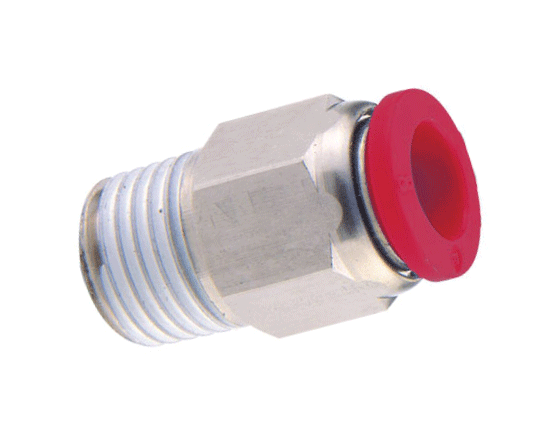
At this time, there does not appear to be a true universal thread that will fit metric and NPT ports and provide an acceptable level of thread sealing to prevent compressed air leakage.
Some firms do suggest they offer a universal fitting. Check and be sure before buying into this concept. If you find a true universal fitting, do let me know and I’ll note it here. I have seen some that claimed to be, but they did not provide adequate thread-depth penetration or sealing.
Do yourself a huge favor and keep your metric air fittings stored away from your NPT air fittings.
It is not always easy to tell them apart. Some manufacturers use different color release rings for their metric fittings. Unless someone clues you into the color guide though, how will you know which are which?
Metric Fitting Classifications
The common classification for METRIC fitting sizes are “G” type, and “R” type threaded fittings.
G-Type Metric Fittings
The sealing mechanism of the “G” type fitting will be a sealing ring or O-ring placed over the thread of the fitting and butted up to the base of the wrench flats.
The threads in this style will likely be shorter in length than other types of metric fittings. The reason for this is that the G-type fitting is designed to screw right down into a boss.
In other words, you will screw this fitting thread right down until the sealing ring or O-ring squishes between the body of the fitting wrench flats and the boss into which you are threading it, sealing in the compressed air.
G-style fittings come in a variety of air fitting thread size, the most common of which are:
- M3 (3 millimeters)
- M5 (5 millimeters)
- 1/8
- 1/4
- 3/8
- 1/2
Larger sizes in the G-style metric fitting are certainly available, yet the sizes shown seem to be the highest volume in industrial compressed air applications.
R-Type Metric Fittings
The R-type metric threaded fitting has a taper, similar in concept to the National Pipe Taper thread (NPT). However, these are not tapered the same way as the NPT threads are, they are metric. Trying to use an R-type tapered metric thread in an NPT port can create problems such as badly leaking joints to stripped bosses.
Since the R-type threaded fitting has a taper, it too seals by penetrating into the threads of the boss until sufficient threads are in contact with each other (the fitting is tight) to prevent the escape of compressed air.
R-type metric fittings come in a variety of air fitting thread size, the most common are:
- M3 (3 millimeters)
- M5 (5 millimeters)
- 1/8
- 1/4
- 3/8
- 1/2
As with other styles of compressed air fittings, larger fitting sizes in the R-type are available. The sizes shown above are the most common for industrial compressed air valves and cylinders.
You might find this Metric Fitting Hole Size chart useful, too.
Compressed Air Fittings – Considerations
Pressure Rating Considerations
Air fittings often come with pressure ratings to help minimize issues with leaks and potential pressure drops. Without a careful assessment of the system, clamps and couplings can be subjected to pressures beyond their rating which can cause problems. One way this can go undetected is if there are irregular spikes of pressure within the compressed air system.
If the quick-release couplings are exposed to spikes, they will eventually break down the locking elements of the component. You can avoid this eventuality by ensuring that the coupling chosen for the application has a higher rating than the anticipated maximum pressure. Any part of the system that prevents airflow will be problematic for the entire system.
PTFE vs. Paste Thread Sealant vs. Liquid Thread Sealant
Some compressed air professionals prefer not to use this tape. It is too easy for pieces of the tape to overlap the end of the fitting if not carefully applied. The overlapping tape can impede the air passageway.
Since compressed air flows very rapidly, sometimes pieces of the Teflon tape can break off in the air turbulence inside the fitting and create problems downstream by lodging in other air components. For example, pieces of tape can lodge in smaller air orifices and block them, or prevent another sealing surface from closing properly, actually generating a leak.
Yet Teflon tape is convenient, inexpensive, and relatively easy to use. If you do use it, just be careful to keep the tape wound well back from the end of the fitting thread, and do not let the Teflon tape overlap air passages when the fitting is threaded into the hole.
Wind the Teflon tape onto the male threads against the thread, so when the fitting is threaded into the port, the Teflon tape would tend to tighten on the threads rather than loosen.
Lately, it seems air fittings come complete with a paste sealant or other similar type of sealing compound already dried on and coating the fitting threads.
Like the PTFE tape, this sealing compound allows the NPT threads to seat further into the boss thread, allowing greater thread-to-thread contact inside and filling micro-voids and unevenness in the threads to improve the seal. This is a nice feature of modern air fittings and is both readily available and well accepted.
Alternatively, you can purchase liquid thread sealant to add to the threads of your fittings before you thread them into a boss. Using the liquid on smaller fittings is problematic if care is not taken to keep the sealant from overlapping and blocking the actual air passage.
Straight, Elbow, and Rotary Union Fittings
Straight Fittings
Just as its name suggests, the straight fitting accepts an airline (tube or hose) on one end, and on the other, there is an NPT male or female thread that screws into or onto a boss.
The Elbow Fitting
Elbow fittings are those that allow the supplying line to connect to the air fitting tangentially, out to one side, rather than straight in the end.
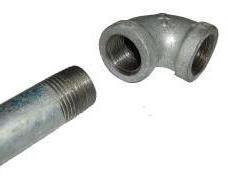
To make the orientation of the airline easier, modern elbows are swivel type. After the thread is screwed tight into the port, the airline connection can be rotated to allow the airline to align in the most convenient direction.
A swivel elbow is NOT a rotary device. The purpose of the typical elbow fitting is NOT to allow a continuous movement of the swivel as the equipment moves. The use of a standard moveable elbow fitting as a rotary union will result in fitting failure fairly quickly.
If the elbow fitting is to be swiveling continuously, by a reciprocating part or some such on a machine, install a purpose-designed rotary union, NOT a swivel elbow fitting.
Rotary Union
For applications that require a 90-degree elbow that swivels continuously or fully rotates on a continuous basis, a rotary union can be used.
For example, rotary unions are commonly used on index tables, where there is a continuous rotary movement of the air supply line to the table.
I recommend you select a quality-built Rotary Union, one with ball bearings in its construction to allow easy, continuous rotation, one that has the proper seals necessary to ensure reliable, often high-speed, continuous rotation without fitting failure or air leaks.
I promised you information on Metric fittings, and it is on this page.
If you have a question about NPT-type air fittings, please add it here. If you can help another visitor with a question they have posted, we’d all appreciate it.
FAQs (Frequently Asked Questions)
The best thread seal tape for compressed air fittings is PTFE (polytetrafluoroethylene) sealant tape. Some good options are the following: Dixon Valve TTB75 PTFE Industrial sealant tape, Vanguard PTFE thread sealant, Supply Giant PTFE air compressor fitting sealant, or Skylety thread Teflon seal tape.
Just like with the pipe length, the more fittings in the airline, the less pressure you’ll have available at the point of use. Abrupt changes in direction or any disturbance to the airflow will result in a loss of pressure. Therefore, it is imperative to minimize fittings in order to maximize airflow.
To find the correct fitting size of your compressed air fittings, it is generally advised to measure the outer diameter of the threads. The process varies every so slightly for male and female threads. For a male thread, measure the outer diameter (OD) of the thread. For a female thread, measure the top diameter of the opening (OD).
The red tape found on compressed air brass fittings is likely to be PTFE (polytetrafluoroethylene) thread sealant tape. It aids in helping brass fittings connect together along with forming a tighter seal.
Additional Reading:
- Using Aluminum Air Pipe For Compressed Air
- Copper Pipe For Compressed Air
- Galvanized vs Black Pipe For Air, Gas and Water
- Using ABS Pipe For Compressed Air
- Using Nylon Tubing For Compressed Air
- PVC Air Lines
- Using Pex Pipe for Compressed Air Lines – Do’s & Don’ts
- Best Compressed Air Pipeline Materials For Compressed Air Piping Systems
- Steel vs Brass Air Fittings
- Industrial vs Automotive Air Fittings
- Compressed Air Metric Fittings
- Air Hose Fittings Types – Guide To Air Compressor Coupler Types
- Air Compressor Hose & Tube Guide
- Using Pex-Al-Pex Compressed Air & Pex-Al-Pex Fittings
- Pex A vs Pex B Pipe & Fittings
- PEX Fitting Types Guide
- How to Plumb an Air Compressor Setup in Garage
If you have any questions regarding compressed air fittings, please leave a comment below, with a photo if applicable, so that someone can help you!

